Introduction
After formulation defines the optimal conditions for a biologic, drug product development in biologics translates those conditions into a final form suitable for patient administration.
Drug product is not simply the continuation of formulation.
It represents the stage at which the molecule is prepared in its final, deliverable form, where quality, stability, and usability must all be ensured simultaneously.
A well-designed formulation does not guarantee a successful drug product.
The formulation must be implemented in a way that maintains stability, ensures sterility, and delivers the intended dose accurately under real manufacturing and usage conditions.
For this reason, drug product development should be considered not only as a manufacturing step, but as a critical stage where product design is finalized.
1. DP as the Final Quality State
Drug product represents the final quality state of a biologic prior to administration.
At this stage, the molecule must:
- maintain its structural and functional integrity
- remain stable under defined storage conditions
- be compatible with its container and delivery system
Unlike earlier stages, any quality issue at the drug product level directly impacts patient safety and clinical performance.
2. Regulatory Perspective on Drug Product
From a regulatory perspective, drug product is evaluated as the final administered form of the drug.
Key considerations include:
- safety
- efficacy
- sterility
Sterility assurance becomes particularly critical at this stage, as contamination risks cannot be mitigated after final filling.
In addition, consistency in dose delivery and product performance must be demonstrated to ensure reliability across batches.
3. Beyond Quality: Usability and Patient Considerations
In addition to quality and regulatory requirements, drug product design is increasingly influenced by patient usability.
Modern biologics are no longer limited to traditional vial-based administration.
There is a strong trend toward subcutaneous (SC) delivery and high-concentration formulations, enabling more convenient and flexible dosing options.
In many cases, pharmaceutical companies develop proprietary formulation and delivery platforms to support these approaches.
These platforms are often protected by patents and can become key drivers of product differentiation and lifecycle management.
Examples include:
- prefilled syringes and autoinjectors for self-administration
- high-concentration formulations for reduced injection volume
- platform technologies enabling SC conversion of intravenously administered biologics
These developments reflect a shift from purely quality-driven design toward patient-centric and commercially driven strategies.
As a result, drug product development must consider not only stability and manufacturability, but also how the product will be used, differentiated, and adopted in real-world settings.
4. Integration of Device and Formulation
Drug product is increasingly defined not only by its formulation, but also by its delivery system.
As biologics move toward subcutaneous administration and high-concentration formulations, the interaction between formulation and device becomes a critical design factor.
At high protein concentrations, formulation properties such as viscosity and interfacial sensitivity can directly affect device performance, including injectability and dose delivery.
In addition, the use of prefilled syringes and autoinjectors introduces new risks related to material interactions, including:
- adsorption to surfaces
- silicone oil interactions
- extractables and leachables from device components
These interactions can impact both product stability and functionality.
For this reason, formulation development cannot be separated from device considerations.
The formulation must be designed with the final delivery system in mind, rather than adapted later.
In practice, many platform technologies integrate formulation and device design to ensure compatibility and enable reliable product performance.
This reflects a shift from independent component development toward an integrated product design approach.
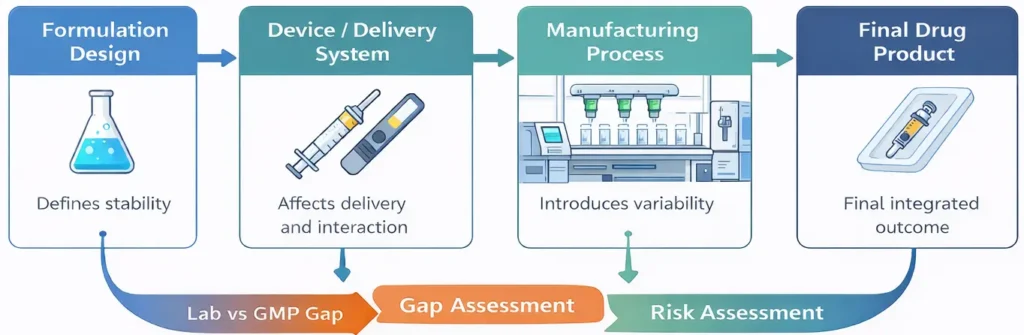
5. From Formulation Design to Manufacturing Reality
Drug product development is not simply the execution of a predefined formulation, but the realization of formulation design under manufacturing conditions.
A formulation that performs well under laboratory conditions does not necessarily behave the same way in a GMP environment.
During development, small-scale and manual operations are often used, such as syringe-based filtration, small membrane areas, or manual filling.
In contrast, manufacturing processes involve larger-scale equipment, automated systems, and different process dynamics.
This difference in process environment introduces additional factors that can affect product quality, including:
- shear stress during pumping and filtration
- interfacial stress during mixing and filling
- variability introduced by manufacturing scale
- exposure to process conditions over time
These factors can alter protein stability, even when the formulation composition remains unchanged.
For this reason, drug product development must evaluate not only formulation stability, but also stability under process-relevant conditions.
In addition, gap assessment between development conditions and manufacturing processes is essential.
This includes evaluating differences in filtration systems, filling approaches, and overall process configuration.
Based on this assessment, risk evaluation should be performed to identify potential impacts on product quality and process robustness.
Without this step, assumptions made during development may not hold under manufacturing conditions..
6. Process and Manufacturing Considerations
During drug product development, manufacturing processes introduce additional sources of variability that must be controlled.
Even when formulation and device design are well defined, process conditions can significantly impact product quality.
Key risk areas include:
- filtration-related stress, which may induce protein loss or aggregation
- filling variability, affecting dose accuracy and consistency
- exposure to process conditions over time, even in nominally continuous operations
- interactions with process surfaces and materials
These risks are not defined by discrete process steps alone, but by how the product is exposed to process conditions throughout manufacturing.
Therefore, process development should focus not only on operational efficiency, but also on understanding and controlling how process conditions influence product quality.ithin defined limits.
7. Why Integration is Critical
Drug product development cannot be approached as a sequence of independent steps.
Formulation, device, and process are tightly interconnected, and decisions made in one area can directly impact outcomes in others.
For example:
- formulation properties such as viscosity and interfacial sensitivity can affect device performance and injectability
- device materials and design can influence product stability through interactions and surface effects
- process conditions can alter protein stability, even when formulation composition remains unchanged
Because of these interdependencies, separating formulation, device, and process development can lead to:
- incompatibility between formulation and delivery system
- unexpected stability issues during manufacturing
- challenges in achieving consistent product performance
Effective drug product development therefore requires an integrated approach, where formulation design, device selection, and process development are considered together from early stages.
8. Key Considerations in DP Development
Drug product development requires a balanced consideration of formulation, device, and process, rather than focusing on a single aspect.
Key considerations include:
- formulation design, including control of aggregation, chemical stability, and excipient selection
- device compatibility, particularly for prefilled syringes and autoinjectors, including material interactions and performance
- process-related exposure, such as filtration, filling, and time-dependent stress during manufacturing
- dosage form selection, including the choice between liquid and lyophilized products based on stability and usability
- container closure systems and associated risks, including extractables and leachables
- integration across formulation, device, and process to ensure consistent product performance
Each of these areas represents not an isolated task, but part of a connected system that defines the final drug product.
These topics will be explored in more detail in the following articles.
Conclusion
Drug product development defines how a biologic is ultimately delivered to the patient.
- Drug product represents the final quality state, where stability, sterility, and dose accuracy must be ensured under real manufacturing and usage conditions.
- Regulatory expectations focus on safety, efficacy, and sterility, making control at the drug product stage critical.
- Drug product design increasingly reflects patient-centric considerations, including delivery devices, administration routes, and convenience.
- Successful development requires a deep integration of formulation, device, and process, rather than sequential or independent approaches.
- A robust drug product is not only well designed, but proven to remain stable and consistent under actual process and device conditions.
→ Read more:
- [Biologics Development Process: From Cell Line to Drug Product]
- [Biologics Formulation Strategy: Beyond Stability and Towards Development Design]
- Lyophilization Cycle Development for Biologics (TBD)
- Viscosity Challenges in High-Concentration Biologics (TBD)
- Container Closure Systems (CCS) in Biologics (TBD)
- Extractables and Leachables (E&L) in Biologics (TBD)
- Hold Time Studies in Biologics Manufacturing (TBD)
- PUPSIT in Sterile Filtration: Regulatory and Practical Considerations (TBD)