As biologics continue to evolve toward patient-friendly formats such as pre-filled syringes (PFS) and auto-injectors, liquid formulations have become increasingly common across the industry.
However, formulation selection in biologic drug development is rarely based on convenience alone. Factors such as protein stability, manufacturability, device compatibility, and global distribution strategy all play important roles during drug product and CMC development [Click to More detail].
Despite advances in formulation science and delivery devices, many companies still choose lyophilized drug products during both clinical and commercial development.
In many cases, lyophilization remains the more practical option from a stability and manufacturing perspective, particularly for complex or high-concentration biologics.
What Is a Lyophilized Biologic?
Lyophilization, or freeze-drying, removes water from a formulated drug product under low temperature and vacuum conditions.
The final product is a dry cake that requires reconstitution before administration.
This approach has long been used for monoclonal antibodies, vaccines, peptides, and other temperature-sensitive biologics.
Why Liquid Formulations Can Be Challenging
Liquid biologics offer convenience, but maintaining long-term stability is often difficult.
Common challenges include:
- Aggregation
- Oxidation
- Fragmentation
- Surface adsorption
The challenge becomes even greater for high-concentration biologics intended for subcutaneous injection.
At concentrations above 100 mg/mL, companies may encounter:
- High viscosity
- Syringeability issues
- Increased aggregation risk
- Filtration and manufacturing limitations
In some cases, a lyophilized formulation becomes the more realistic option.
Advantages of Lyophilized Biologics
Improved Stability
Removing water significantly reduces many degradation pathways and can improve shelf life and storage robustness.
For unstable molecules, lyophilization may provide the most reliable long-term stability strategy.
Manufacturing and Distribution Benefits
Lyophilized products can offer greater flexibility during:
- Global distribution
- Cold chain transport
- Long-term storage
- Commercial scale-up
This can become important when stability margins are limited in liquid form.
Challenges of Lyophilization
Lyophilization also introduces additional complexity.
Development teams must carefully optimize:
- Freezing conditions
- Drying parameters
- Residual moisture
- Reconstitution performance
Manufacturing cycles are typically longer and require specialized equipment compared with liquid filling processes.
Why Companies Still Choose It
In practice, formulation decisions are rarely based on convenience alone.
Companies must balance:
- Stability
- Manufacturability
- Commercial feasibility
- Device strategy
- Global supply considerations
For some biologics, a stable lyophilized product may simply represent the lowest overall development risk.
Future Direction: Combining Stability and Convenience
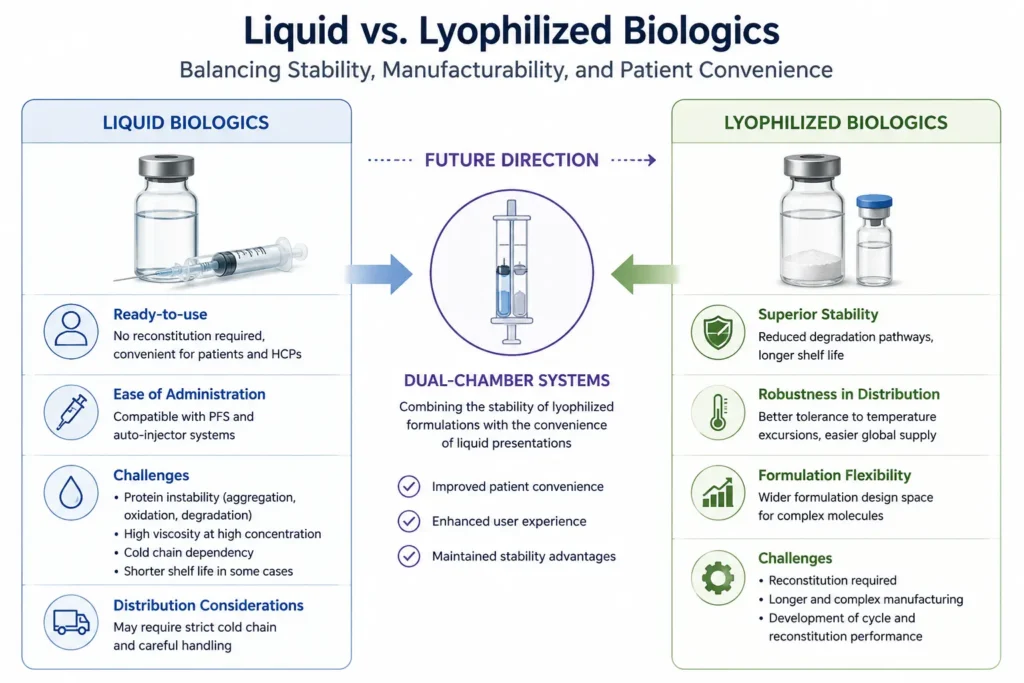
Although lyophilized biologics remain important, the industry continues moving toward more convenient drug product presentations.
Prefilled syringes, autoinjectors, and ready-to-use systems are increasingly preferred from both patient and clinical workflow perspectives.
As a result, advanced technologies such as dual-chamber syringes and dual-chamber cartridges are receiving growing attention. These systems attempt to combine the stability advantages of lyophilized formulations with the convenience of liquid products.
Rather than disappearing, lyophilization is likely to evolve alongside next-generation delivery systems as biologics become more complex and patient-centric.