Why Pharma Companies Are Paying Attention to AI
AI in pharmaceutical development has become one of the biggest topics in the pharmaceutical industry. Over the past few years, collaborations between major pharmaceutical companies and AI-focused technology companies have increased rapidly, drawing significant attention across both biotech and healthcare sectors.
At first glance, the reason seems obvious: faster drug development.
However, the real value of AI in pharmaceutical development is more complex than simply discovering new molecules faster.
Drug development is an extremely long and iterative process involving formulation development, analytical characterization, process optimization, manufacturing scale-up, regulatory documentation, and commercial readiness. In many cases, these downstream activities become larger bottlenecks than the initial discovery stage itself.
As development costs continue to rise, pharmaceutical companies are increasingly interested in technologies that can reduce inefficiencies across the entire development lifecycle.
Why AI in Pharmaceutical Development Matters
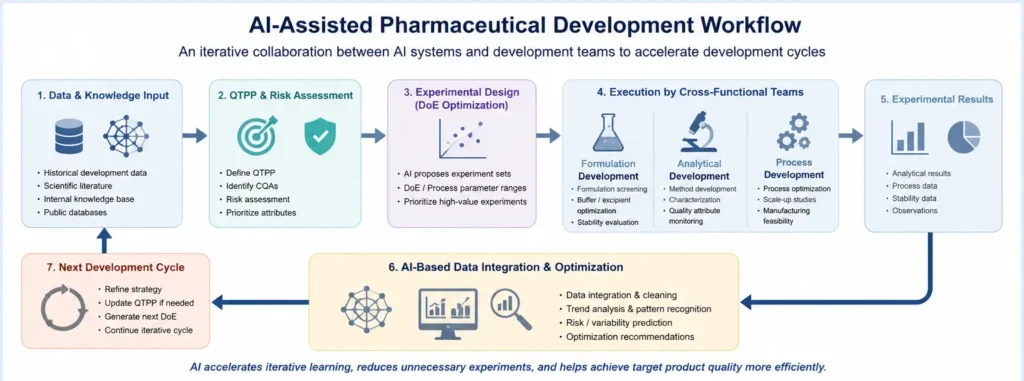
Modern pharmaceutical development already follows highly structured scientific frameworks such as:
- Quality by Design (QbD)
- Quality Target Product Profile (QTPP)
- Critical Quality Attribute (CQA) assessment
- Design of Experiments (DoE)
- Risk-based development strategies
These approaches are fundamentally data-driven and iterative.
Development teams repeatedly:
- Define target product characteristics
- Design experiments
- Generate data
- Analyze trends and risks
- Refine development strategies
- Repeat optimization cycles
This process can require enormous amounts of time, resources, and cross-functional coordination, especially in biologics development where formulation development (click to post), manufacturing processes (click to post), analytical characterization, and regulatory activities are tightly interconnected.
AI becomes attractive because it may significantly accelerate these iterative cycles.
Rather than changing the scientific framework itself, AI may improve how quickly development teams can approach desired product quality targets and identify optimal development pathways.
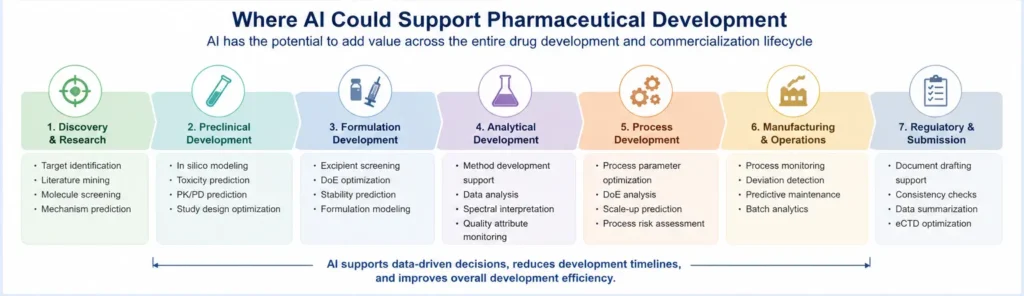
Where AI Could Play a Role
Faster Data Interpretation
Pharmaceutical development generates large amounts of experimental and manufacturing data.
AI systems may help identify:
- Parameter relationships
- Development trends
- High-risk conditions
- Process variability
- Stability patterns
more quickly than traditional manual review approaches.
This could reduce the time required to interpret complex datasets and support faster decision-making.
More Efficient Experimental Design
One of the most time-consuming parts of development is repeated experimental optimization.
AI-assisted systems may help:
- Predict promising formulation conditions
- Suggest optimized process parameters
- Reduce unnecessary experimental iterations
- Prioritize higher-probability development paths
This could improve development efficiency while maintaining existing QbD and DoE-based approaches.
Regulatory and Documentation Support
CMC and regulatory activities also require significant manual effort.
Development teams must continuously organize:
- Analytical data
- Manufacturing information
- Stability results
- Batch records
- Technical reports
- Submission documents
AI-assisted drafting and knowledge management tools may eventually help reduce repetitive documentation workload and improve consistency across development programs.
AI Will Still Require Real Experimental Verification
Despite growing interest in AI, pharmaceutical development cannot rely entirely on simulations or predictive models.
Proposed formulation conditions, manufacturing parameters, and development strategies must still be verified through real experimental work.
Development teams must confirm:
- Product quality
- Stability
- Safety-related risks
- Manufacturing consistency
- Regulatory suitability
using actual laboratory and manufacturing data.
For this reason, AI is unlikely to replace scientists, engineers, or development teams entirely.
Instead, AI may function as a centralized optimization and decision-support system that works alongside existing development organizations.
A Possible Future Development Model
One possible future workflow is a highly iterative collaboration between AI systems and specialized development teams.
For example:
- AI proposes optimized development strategies based on QTPP targets and historical datasets
- Formulation, analytical, and process development teams perform assigned experimental studies
- Experimental results are collected and integrated into centralized datasets
- AI evaluates trends, risks, and parameter relationships
- Updated experimental strategies and optimization paths are generated
In this model, the main advantage of AI is not replacing scientific expertise, but accelerating development coordination, data interpretation, and iterative optimization across the entire pharmaceutical development process.
Current Limitations of AI in Pharma
Despite rapid progress, several important limitations still remain.
Limited Experimental Understanding
AI can identify correlations and patterns, but pharmaceutical development often requires mechanistic scientific understanding and risk-based interpretation.
Unexpected experimental outcomes, formulation instability, or manufacturing deviations still require experienced scientific judgment.
Data Quality and Integration Challenges
AI performance depends heavily on data quality.
However, pharmaceutical development data is often:
- Fragmented across systems
- Inconsistently structured
- Generated using different analytical methods
- Difficult to standardize
Poor data integration can significantly reduce the effectiveness of AI-supported analysis.
Regulatory and Validation Expectations
Pharmaceutical development remains a highly regulated industry.
Even if AI proposes optimized strategies, companies must still demonstrate that development decisions are scientifically justified, reproducible, and properly validated.
Regulatory agencies will likely continue requiring robust experimental evidence rather than relying solely on AI-generated conclusions.
Final Thoughts
AI is unlikely to completely transform pharmaceutical development overnight.
However, it may significantly improve how efficiently development teams process data, optimize experiments, and coordinate complex development activities.
The core scientific principles of pharmaceutical development — including QTPP, QbD, DoE, and risk-based decision-making — will likely remain unchanged.
Instead, AI may become a powerful tool for accelerating iterative development cycles and reducing inefficiencies across discovery, development, manufacturing, and commercialization.
As biologics become increasingly complex and development timelines become more important, this is one reason why pharmaceutical companies are paying close attention to AI-driven development strategies.