SC conversion in biologics has become one of the biggest trends in modern pharmaceutical development. Over the past several years, many pharmaceutical companies have actively pursued strategies to convert intravenous (IV) biologics into SC formulations.
At first glance, the reason appears simple: patient convenience.
However, the growing industry interest in SC biologics is driven by much broader clinical, commercial, and manufacturing considerations.
As biologics become increasingly competitive, SC conversion is now viewed not only as a formulation challenge, but also as a major lifecycle management and delivery platform strategy.
Why Companies Want SC Biologics
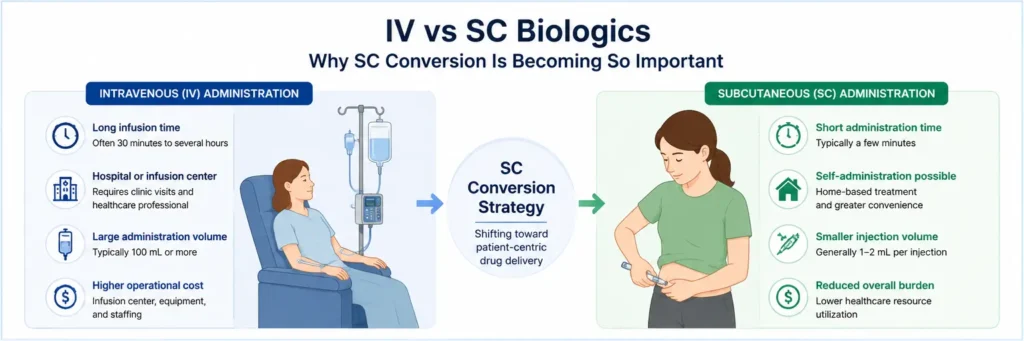
Traditional IV biologics often require:
- Long infusion times
- Hospital or infusion center visits
- Healthcare professional administration
- Higher operational costs
In contrast, SC formulations may offer:
- Shorter administration times
- Improved patient convenience
- Potential self-administration
- Reduced infusion center burden
- Greater flexibility in treatment settings
For chronic diseases requiring long-term treatment, these advantages can significantly improve patient experience and treatment accessibility.
Why SC Conversion in Biologics Is Difficult
Despite its advantages, SC conversion is not straightforward for many biologics.
One of the biggest limitations is injection volume.
SC administration is generally limited to relatively small injection volumes compared with IV infusion. However, many monoclonal antibodies require large doses, particularly at higher body-weight-based regimens.
This creates several formulation challenges:
- High protein concentration requirements
- Increased viscosity
- Syringeability limitations
- Injection discomfort
- Stability concerns
As a result, converting an IV biologic into an SC product often requires extensive formulation and device optimization [Click to details].
Why High-Concentration Formulation Matters
To enable SC delivery, companies frequently develop high-concentration formulations that can deliver larger doses in smaller injection volumes.
However, high-concentration biologics introduce additional complexity during formulation and manufacturing development.
Challenges may include:
- Protein aggregation
- Increased particle formation
- Filtration difficulty
- Higher viscosity during filling
- Stability risks during storage
This is one reason why formulation development has become increasingly important in modern biologics programs.
How PH20 Changed SC Biologics
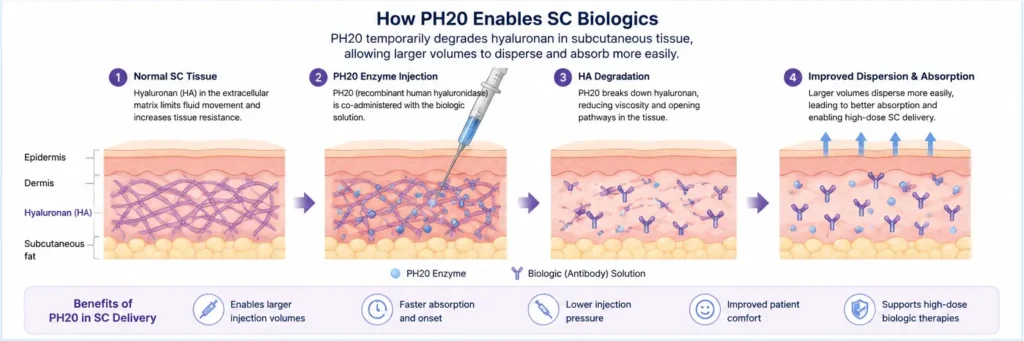
One technology that significantly accelerated SC conversion strategies is recombinant human hyaluronidase PH20 (rHuPH20).
PH20 temporarily degrades hyaluronan in subcutaneous tissue, allowing larger fluid volumes to disperse more easily after injection.
This enables:
- Larger SC injection volumes
- Faster absorption
- Reduced injection pressure
- More practical administration of high-dose biologics
As a result, PH20 became an important enabling technology for many SC biologics programs.
Why Pharma Companies Are Interested in PH20 Platforms
The growing interest in PH20 is not simply about one enzyme technology.
Instead, PH20 represents a broader industry shift toward:
- SC conversion strategies
- Patient-centric drug delivery
- Lifecycle management
- Differentiated biologic products
- Home-based administration
For major biologics products, successful SC conversion can potentially extend product competitiveness while improving convenience for both patients and healthcare systems.
This is one reason why licensing agreements, platform collaborations, and patent-related discussions around SC delivery technologies continue to attract significant industry attention.
SC Conversion Is More Than a Formulation Problem
In practice, successful SC biologics development requires coordination across multiple areas, including:
- Formulation development
- Device compatibility
- Manufacturing feasibility
- Analytical characterization
- Clinical usability
- Regulatory strategy
Because of this, SC conversion is increasingly viewed as a cross-functional development strategy rather than a simple formulation modification.
Future Outlook for SC Biologics
The biologics industry continues moving toward more convenient and patient-friendly delivery systems.
In addition to PH20-based approaches, companies are actively exploring:
- Wearable injectors
- Dual-chamber systems
- High-volume SC devices
- Next-generation injection platforms
As biologics become more complex and long-term treatment demands increase, SC conversion will likely remain one of the most important development strategies across the pharmaceutical industry.