Why UF/DF Troubleshooting Is More Than Just Process Adjustment
UF/DF troubleshooting biologics is often more complex than it appears. Ultrafiltration and diafiltration (UF/DF) are often described as straightforward unit operations used for concentration and buffer exchange. In practice, however, UF/DF-related issues rarely originate from the filtration step alone.
Most UF/DF challenges are the result of interactions between protein properties, formulation conditions, and process parameters. Because of this, troubleshooting UF/DF is not simply about adjusting filtration settings—it often requires a broader understanding of how upstream decisions impact downstream performance.
If you need a quick overview of how UF/DF systems are configured and operated, refer to this guide:
👉 Here
UF/DF Troubleshooting Biologics: Common Issues Overview
Several common issues are frequently observed during UF/DF operations in biologics manufacturing:
- Flux decline and membrane fouling
Typically caused by protein aggregation, concentration polarization, or protein–membrane interactions. - Incomplete buffer exchange
Often related to insufficient diafiltration volume or suboptimal mixing conditions. - Protein instability during UF/DF
Changes in pH or ionic strength during buffer exchange can induce aggregation or structural changes. - Extended processing time
Reduced flux increases overall process time, which may introduce additional operational risks.
These issues are well known and relatively easy to describe. However, in many cases, they are only symptoms rather than the root cause.
Why UF/DF Issues Often Originate from Formulation Changes
In real development scenarios, UF/DF performance is highly dependent on formulation conditions.
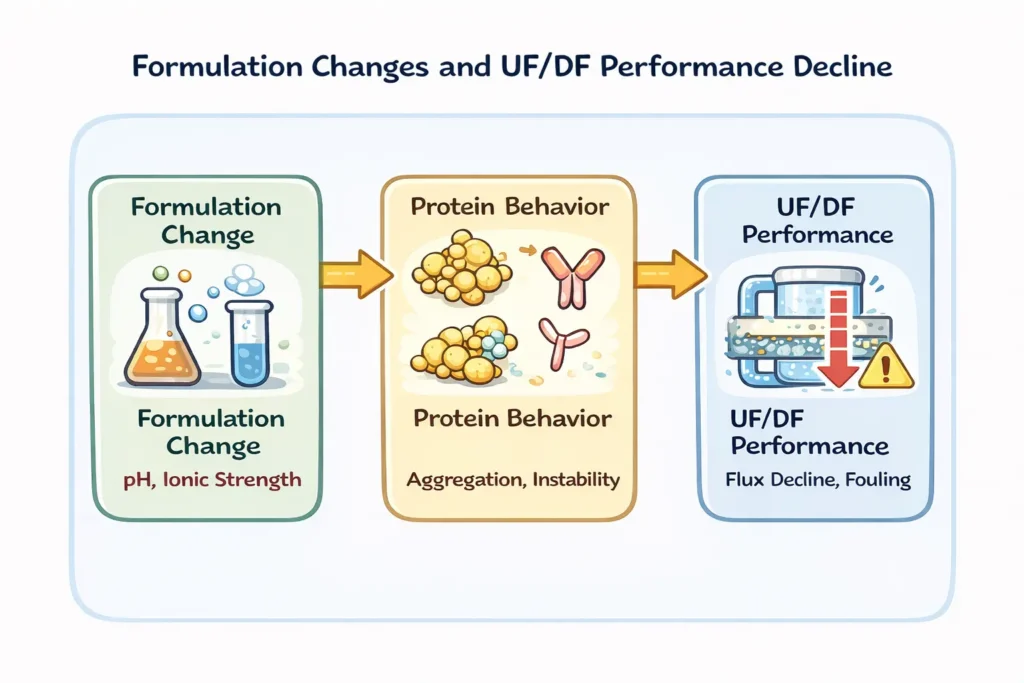
Changes in buffer composition, pH, or excipient systems can significantly alter protein behavior. These changes may affect solution viscosity, protein–protein interactions, and protein–membrane interactions, all of which directly influence filtration performance.
As a result, UF/DF conditions that previously worked well may no longer be suitable after a formulation change. What appears to be a filtration issue is often a consequence of altered formulation characteristics.
This interdependency is frequently underestimated, especially when formulation development and process development are treated as separate activities.
When Formulation Changes Trigger UF/DF Redevelopment
One of the most common challenges in biologics development is the need to revisit UF/DF conditions following formulation updates.
Typical examples include:
- Buffer composition changes
Even minor adjustments in buffer components can alter protein interactions and fouling behavior. - pH adjustments
Shifts in pH may change protein charge distribution, affecting both stability and membrane interactions. - Excipient introduction or modification
Stabilizers, surfactants, or other excipients can influence filtration performance in unexpected ways.
In these situations, UF/DF is no longer a fixed unit operation. Instead, it becomes a process that must be re-evaluated and, in some cases, partially or fully redeveloped.
This is a key reason why formulation strategy and process development must be closely aligned throughout development.
Impact of Process Parameters and Materials
While formulation plays a critical role, UF/DF performance is also sensitive to process parameters and materials.
Variables such as transmembrane pressure (TMP), crossflow rate, and membrane type can significantly affect flux behavior and fouling tendencies. In addition, differences between membrane suppliers or materials may lead to variations in protein binding or filtration efficiency.
However, these factors are often secondary to formulation-driven effects. Adjusting process parameters alone may not resolve issues if the underlying cause is related to formulation.
How UF/DF Issues Impact Final Product Quality
UF/DF-related challenges are not limited to process inefficiencies. They can directly impact critical quality attributes (CQAs) of the final product.
For example, protein aggregation, charge variant distribution, and overall stability can all be influenced by UF/DF conditions. Therefore, issues observed during filtration may ultimately translate into product quality risks.
For a broader overview of how UF/DF fits into the overall process: https://bibimbio.com/cmc-manufacturing/uf-df-buffer-exchange-biologics/
Final Thoughts: UF/DF as a System, Not a Step
UF/DF should not be treated as an isolated unit operation. Instead, it should be viewed as part of a larger system where formulation, process conditions, and materials are closely interconnected.
In practice, many UF/DF issues cannot be resolved by adjusting filtration parameters alone. Understanding the relationship between formulation changes and filtration performance is essential for effective troubleshooting and robust process development.