What Is UF/DF Buffer Exchange in Biologics Manufacturing?
Ultrafiltration and diafiltration (UF/DF) is a key unit operation in biologics manufacturing used to concentrate protein solutions and exchange buffers. While it is often described as a simple step to adjust formulation conditions, UF/DF plays a much more critical role in defining the final quality of the drug substance before it proceeds to drug product manufacturing (Read more: Biologics Development Process: From Cell Line to Drug Product (Pillar Page)).
In practice, UF/DF is typically positioned at the end of downstream processing, acting as a bridge between purification and formulation. At this stage, the protein has already passed major purification steps such as Protein A chromatography and polishing. However, the solution environment is still not suitable for long-term stability or final product requirements. As part of the downstream purification process, this step prepares the molecule for transition into formulation conditions (Read more: Downstream Processing in Biologics: Process Flow and Development Strategy).
Why Buffer Exchange Is Required After Downstream Processing
Removal of Process-Related Impurities
Even after multiple purification steps, the process stream still contains residual components such as salts, elution buffers, and trace impurities. These components may not directly violate specifications but can impact protein stability or downstream compatibility.
UF/DF enables the controlled removal of these components by continuously replacing the existing buffer with a target formulation buffer. This ensures that the protein is transferred into a defined chemical environment suitable for further processing.
Transition to Formulation Buffer
Downstream purification buffers are typically optimized for process efficiency, not product stability. For example, low pH elution buffers used in Protein A chromatography are not suitable for long-term storage.
Through diafiltration, the protein solution is transitioned into a formulation buffer that supports stability, minimizes aggregation, and aligns with the intended drug product design. This transition is closely linked to formulation strategy decisions (see: Biologics Formulation Strategy: Beyond Stability and Towards Development Design).
Control of pH and Ionic Strength
One of the most critical roles of UF/DF is resetting the pH and ionic strength of the solution. These parameters directly influence protein structure, charge distribution, and aggregation behavior.
Unlike simple dilution, UF/DF allows for precise and reproducible control of these parameters, making it an essential step for meeting formulation specifications.
What Happens If Buffer Exchange Is Not Properly Performed
Aggregation and Stability Issues
Incomplete or inefficient buffer exchange can leave residual components that destabilize the protein. This can lead to increased aggregation, especially during storage or stress conditions.
In addition, UF/DF is not only a buffer exchange step but also a concentration step. In many modern biologics, especially high-concentration formulations, the protein is often concentrated beyond its final target level to enable efficient formulation adjustments.
During this process, the protein may temporarily reach ultra-high concentrations, significantly increasing the risk of aggregation or even visible precipitation. These risks are highly dependent on protein properties, buffer composition, and process conditions.
In practice, aggregation or precipitation observed after UF/DF is often attributed to formulation instability, but it can originate from transient high-concentration conditions during the UF/DF step itself.
pH Shift and Specification Failure
If UF/DF is not properly controlled, the final pH may deviate from the target range. This is particularly critical in biologics, where even small pH shifts can affect protein charge variants and overall product quality.
In addition to pH control, incomplete buffer exchange can also affect excipient composition, particularly in high-concentration formulations. Components such as trehalose or mannitol may not be fully exchanged even after multiple diafiltration volumes.
Performing 8–10 diafiltration volumes does not always guarantee complete replacement of the original buffer system, and residual concentration differences can remain. This becomes more critical in high-concentration biologics, where excipient levels are closely tied to stability and viscosity.
As a result, it is not uncommon to verify excipient concentrations after UF/DF and adjust them through post-process spiking to meet formulation targets.
Impact on Drug Product Quality
Since UF/DF defines the solution environment entering drug product manufacturing, it directly determines whether the intended formulation design is achieved.
In biologics development, excipients are selected through formulation studies based on their impact on thermal stability, aggregation behavior, and short- to mid-term storage stability. Their target concentrations are carefully defined to ensure product robustness (see: formulation development strategy).
If UF/DF does not achieve the intended buffer composition or excipient levels, the final solution may deviate from the formulation conditions that were originally proven to be stable.
This disconnect can lead to unexpected stability issues, even when the formulation itself was appropriately designed.
As a result, UF/DF should not be viewed as an isolated unit operation, but rather as a critical step that must accurately translate formulation design into actual product composition, directly impacting drug product quality.
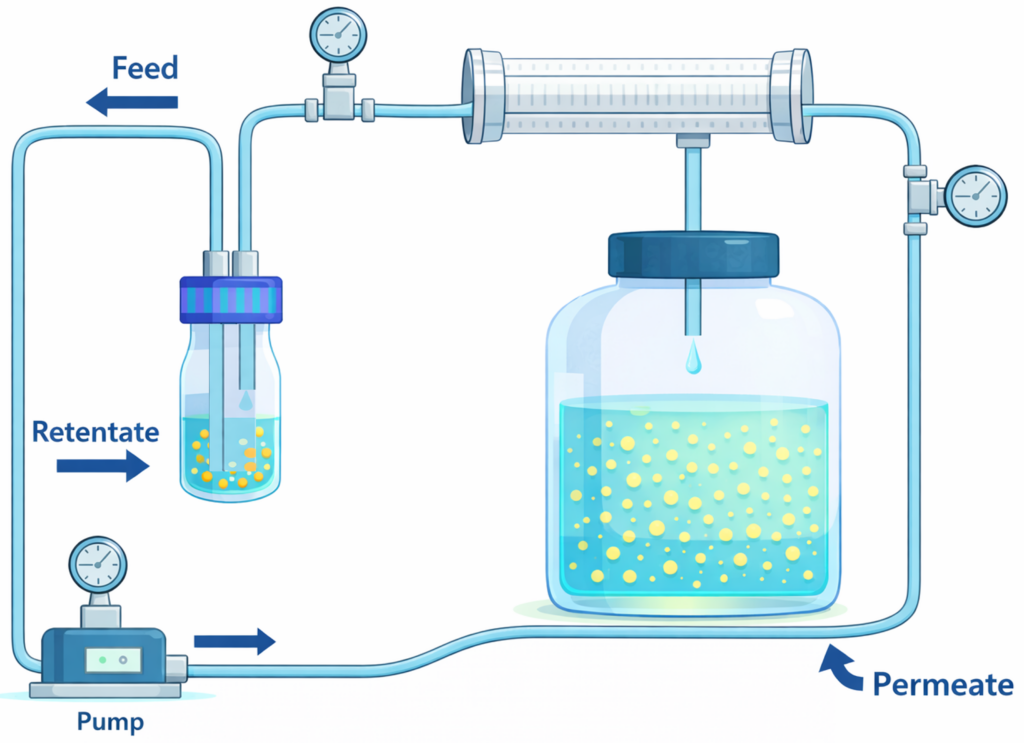
Practical Considerations in UF/DF Operations
Diafiltration Volume and Efficiency
The number of diafiltration volumes (DVs) directly affects buffer exchange efficiency. While increasing DV improves impurity removal, it also increases processing time and operational cost.
A balance must be established between achieving sufficient exchange and maintaining process efficiency.
Membrane Selection and Fouling Risks
Membrane characteristics, such as molecular weight cutoff (MWCO), influence both protein retention and impurity clearance.
Membrane fouling is a common challenge that can reduce flux, increase processing time, and introduce variability. Proper selection and process optimization are essential to mitigate these risks.
Process Control and Variability
UF/DF performance is sensitive to operating conditions such as transmembrane pressure (TMP), flow rate, and protein concentration.
Variability in these parameters can lead to inconsistent buffer exchange efficiency, making process control strategies critical for robust manufacturing.
Conclusion
UF/DF buffer exchange is not merely a routine step but a critical operation that defines whether formulation design is successfully implemented at the process level.
It serves as the point where purification output is transformed into a formulation-ready state, bridging upstream decisions and downstream product performance. Given its impact on concentration, excipient composition, and solution environment, UF/DF plays a central role in ensuring that biologics maintain their intended stability and quality throughout manufacturing and storage.