Introduction
The biosimilar phase 3 requirement is increasingly being discussed as regulatory expectations evolve.
Biosimilar development is evolving, and one of the most discussed topics today is whether Phase 3 trials are still required. Understanding the role of clinical trial phases is essential to interpreting this shift.
Traditionally, clinical development has followed a structured sequence of Phase 1, Phase 2, and Phase 3 studies. However, biosimilars have already challenged this paradigm by removing certain phases, and further changes are now being actively discussed.
To understand this shift, it is important to first revisit what each clinical phase is designed to do, and how biosimilars have historically approached clinical development.
Understanding Clinical Trial Phases in Biosimilars (A Simple Explanation)
Clinical trials are generally divided into three main phases, each serving a distinct purpose.
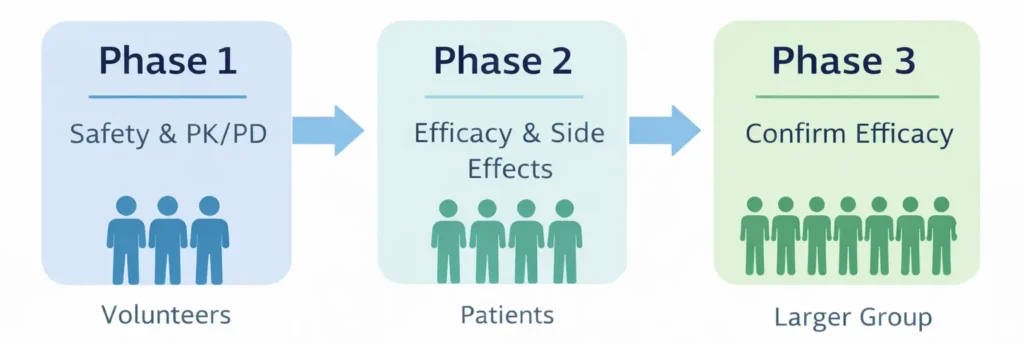
Phase 1: Safety and PK/PD
Phase 1 studies are the first step in testing a drug in humans.
The main objective is to determine whether the drug is safe and how it behaves in the body.
This includes:
- Safety and tolerability
- Pharmacokinetics (how the drug is absorbed, distributed, and eliminated)
- Pharmacodynamics (how the drug affects the body, when measurable)
In simple terms, Phase 1 answers the question:
“Is it safe to give this drug to humans?”
Phase 2: Dose Finding
Phase 2 focuses on identifying the appropriate dose for patients.
This involves:
- Comparing multiple dose levels
- Evaluating early signs of efficacy
- Balancing efficacy and safety
In simple terms, Phase 2 answers:
“What dose should be used?”
Phase 3: Confirmatory Efficacy
Phase 3 studies are large-scale trials conducted in patients to confirm that the drug is effective and safe in real-world conditions.
These studies typically involve:
- Large patient populations
- Comparison against standard treatment or placebo
- Statistical confirmation of efficacy
In simple terms, Phase 3 answers:
“Does this drug actually work in patients?”
Why Biosimilars Skipped Phase 2 — and Now Question Phase 3
Biosimilars are fundamentally different from novel drugs.
They are not developed to discover new efficacy or optimal dosing, but rather to demonstrate high similarity to an already approved reference product.
Why Phase 2 Was Not Required
In biosimilar development:
- The dose has already been established by the reference product
- The mechanism of action is already well understood
- Clinical efficacy has already been demonstrated
As a result, Phase 2—whose primary role is dose finding and early efficacy—became unnecessary in most cases.
Why Phase 1 and Phase 3 Were Traditionally Retained
Despite the removal of Phase 2, biosimilars have typically included:
- Phase 1 studies to demonstrate PK/PD similarity
- Phase 3 studies to confirm no clinically meaningful differences
Phase 3, in particular, has been viewed as a confirmatory step to address any residual uncertainty not captured by analytical or PK data.
Why Phase 3 Is Now Being Reconsidered
Recent regulatory discussions suggest a shift toward a more analytical-driven approach in biosimilar development.
According to guidance such as the FDA’s Scientific Considerations in Demonstrating Biosimilarity (click to FDA) , greater emphasis is being placed on the totality of evidence, particularly analytical and PK/PD data.
In parallel, the EMA has also introduced the concept of a “tailored clinical approach”(Click to EMA) through its reflection paper on biosimilar development. This approach indicates that the need for comparative efficacy studies may be reduced or justified on a case-by-case basis, depending on the strength of analytical and functional evidence.
Advancements in analytical characterization now allow for:
- Detailed structural and functional comparison
- High sensitivity in detecting differences
- Greater confidence in demonstrating similarity without large clinical trials
In addition, strong PK/PD data are increasingly recognized as highly sensitive indicators of comparability.
As a result, the necessity of large confirmatory Phase 3 studies is being actively reconsidered in certain cases, although this shift has not yet been fully formalized across all regulatory frameworks.
Not All Drugs Follow the Same Path
While this trend is evident for biosimilars, it cannot be generalized across all biologics.
For novel drugs, clinical development still relies heavily on all three phases.
Novel Biologics and Dose Uncertainty
In novel biologics such as fusion proteins:
- Dose-response relationships may not be fully understood
- PK/PD relationships can be complex
- Biomarkers may be limited
As a result, Phase 2 remains critical for identifying an appropriate dosing strategy.
ADCs: A More Complex Case
Antibody-drug conjugates (ADCs) introduce additional complexity due to their multi-component structure.
Key considerations include:
- Payload-driven toxicity
- Linker stability and release kinetics
- Complex pharmacokinetics involving multiple species
In ADC development:
- Phase 1 often determines the maximum tolerated dose (MTD)
- Phase 2 plays a key role in refining the therapeutic window
This means that, unlike biosimilars, Phase 2 may be even more critical for certain modalities.
What This Trend Really Means
While there is a clear trend toward reducing reliance on large confirmatory trials, regulatory expectations have not been fully standardized.
Current discussions from regulatory agencies such as FDA and EMA suggest a shift in direction rather than a finalized framework.
As a result:
- The role of Phase 3 in biosimilar development is becoming more flexible
- Decisions are increasingly based on the totality of evidence
- Requirements may vary depending on product characteristics
Close attention should be paid to how regulatory expectations evolve in the coming years.
Conclusion
The role of clinical trials in biosimilar development is clearly evolving.
Phase 2 has already been largely removed due to its limited relevance, and Phase 3 is now being reconsidered as analytical and PK/PD capabilities improve.
However, this does not mean that clinical studies are universally becoming optional.
Instead, the industry is moving toward a more flexible, science-driven approach, where the necessity of each clinical phase depends on the specific characteristics of the product.