Introduction
Cell line development in biologics is a critical stage where CQAs (Critical Quality Attributes) begin to be defined and evaluated. While productivity and stability are often primary selection criteria, defining appropriate Critical Quality Attributes (CQAs) at this stage is essential to ensure downstream process robustness and regulatory compliance.
In practice, CQAs are not simply identified. They are interpreted, prioritized, and managed under conditions of limited process understanding. This article focuses on how CQAs are practically defined and controlled during cell line development.
CQAs in Biologics Cell Line Development
Critical Quality Attributes (CQAs) are defined as physical, chemical, biological, or microbiological properties that must be controlled within appropriate limits to ensure product quality (ICH Q8(R2)).
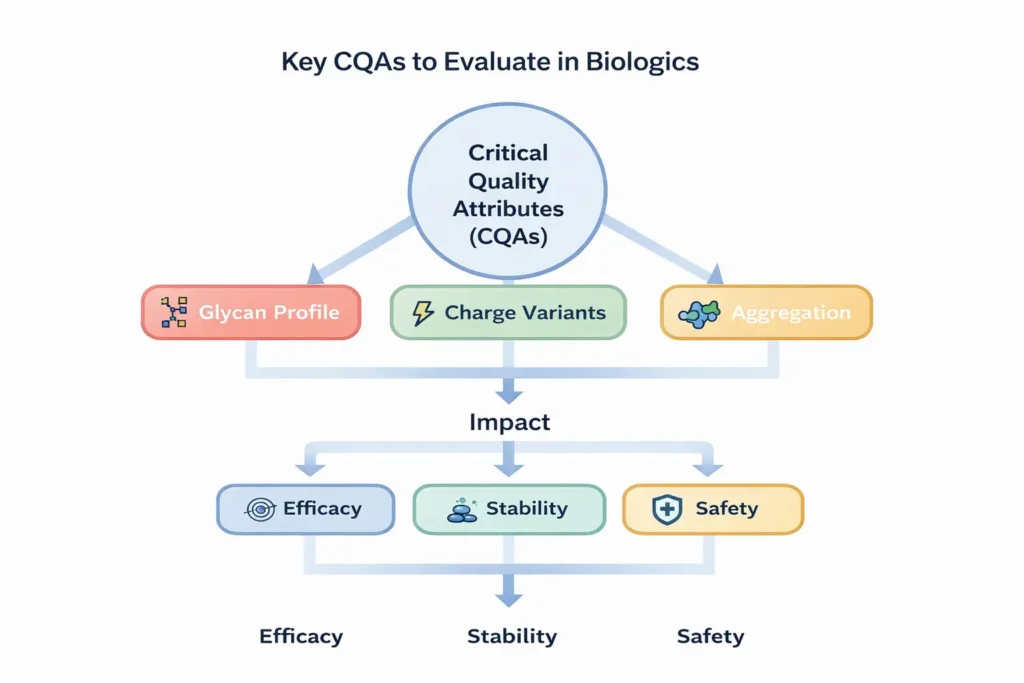
For monoclonal antibodies and other protein therapeutics, typical CQAs include:
- Glycosylation profile (e.g., G0F, G1F, G2F distribution)
- Sialic acid content
- Charge variants (acidic and basic species)
- Aggregation levels
- Post-translational modifications (oxidation, deamidation)
Among these, glycosylation is particularly important because it can directly affect biological activity, immunogenicity, and serum half-life (Walsh & Jefferis, Nat Biotechnol, 2006). These attributes are influenced not only by the cell line itself but also by culture conditions and process parameters, which makes early-stage control inherently complex.
Regulatory Perspective
From a regulatory standpoint, CQAs must be defined and justified based on their potential impact on product safety and efficacy.
- ICH Q6B emphasizes the need to characterize product-related variants, including glycoforms and charge variants
- ICH Q8(R2) introduces a Quality by Design (QbD) framework, linking CQAs to process understanding and control strategy
- Regulatory agencies expect a clear rationale for CQA selection, even at early development stages
At the cell line stage, regulators do not expect full control, but they do expect a scientifically justified approach to identifying and monitoring critical attributes.
Practical Challenges in Defining CQAs Early
At the cell line development stage, both product understanding and process understanding are inherently limited. Upstream conditions are not fully optimized, and scale-up effects are not yet characterized. As a result, the available data for defining CQAs is often incomplete and may not fully represent later-stage manufacturing conditions.
This creates a fundamental challenge: CQAs still need to be considered and used for clone selection, even though they are being defined based on limited and evolving information.
In practice, this means that early CQA assessment is not about defining precise specifications, but about identifying attributes that are likely to show variability and have a meaningful impact on product quality. Attributes such as glycosylation profile, charge variants, and sialic acid content are particularly important at this stage, as they are influenced by the cell line and are not easily corrected in downstream processes.
Because these attributes may shift during process optimization and scale-up, it is difficult to establish fixed acceptance criteria early on. Instead, a more practical approach is to evaluate trends, relative differences between clones, and the potential risk associated with observed variability.
Ultimately, despite the uncertainty, CQA-driven clone selection is unavoidable. Therefore, selecting the right set of CQAs—those most likely to vary and impact downstream performance—is critical for making informed early-stage decisions.
How CQAs Are Practically Defined
In practice, defining CQAs during cell line development is closely linked to clone selection rather than being treated as an isolated analytical exercise.
Clone-to-clone variability is a well-recognized challenge, where different clones may exhibit differences in glycosylation profiles, charge variants, aggregation propensity, and overall stability. Importantly, not all of these differences can be fully corrected during downstream processing or formulation development.
For example, while certain impurities or variants may be partially reduced during purification, intrinsic product quality attributes such as glycosylation patterns are largely determined at the cell line and upstream process level. As a result, early decisions made during clone selection can have a lasting impact on the overall development strategy.
Because there is no absolute standard for an “ideal” quality profile at this stage, defining appropriate selection criteria becomes a critical task. Rather than targeting fixed values, CQAs are typically evaluated within acceptable ranges, taking into account both product quality and process feasibility.
At the same time, clone selection cannot rely solely on quality attributes. Other key factors such as cell viability, growth characteristics, and productivity must also be considered. In many cases, trade-offs are unavoidable, such as selecting between a clone with superior productivity but less optimal glycan distribution, or a clone with better quality attributes but lower yield.
This highlights the importance of cross-functional collaboration. Effective clone selection requires close alignment between process development, analytical, and formulation teams to ensure that decisions are made based on a holistic understanding of both product quality and manufacturability. Ultimately, CQAs at the cell line stage should not be viewed as fixed targets, but as part of a broader decision-making framework that balances quality, process robustness, and downstream impact.
Key Decision Considerations Across CMC Development
In practice, clone selection and early CQA definition should not be evaluated in isolation. Instead, decisions should be made from a broader CMC perspective, considering how the selected cell line will perform across upstream and downstream development.
From a CMC perspective, the following aspects should be considered:
- Stability of the selected clone and consistency of product quality attributes
- Suitability for the intended upstream process (e.g., fed-batch or perfusion)
- Ability to maintain viability and productivity during scale-up
- Compatibility with downstream purification, including removal of charge and size variants
- Risk of yield loss during impurity clearance
- Alignment with future control strategy and process robustness
From an upstream standpoint, it is particularly important to recognize that performance observed in small-scale systems may not translate directly to larger bioreactors. This is especially relevant when implementing specific culture strategies such as perfusion, where process conditions differ significantly from flask-based models. From a downstream perspective, the selected clone should enable efficient impurity removal without compromising yield or product quality. Failure to consider these factors early can lead to significant rework during later development stages.
Conclusion
Defining CQAs during cell line development is not a checklist-driven activity, but a decision-making process under uncertainty. At this stage, both product understanding and process knowledge are inherently limited, making it necessary to establish scientifically justified and flexible criteria rather than fixed specifications.
In practice, successful clone selection depends on balancing multiple factors, including product quality attributes, productivity, scalability, and downstream process compatibility. Since certain attributes—such as glycosylation profiles, charge variants, and aggregation tendencies—cannot be fully corrected in later stages, early alignment is critical to avoid unnecessary redevelopment.
A practical approach therefore involves selecting clones based not only on analytical results, but also on their overall developability within the intended CMC strategy. This requires close collaboration between upstream, downstream, and analytical teams to ensure that selected clones are both scientifically sound and manufacturable. Ultimately, early CQA definition should be viewed as the foundation for the entire development lifecycle, directly influencing process robustness, control strategy, and long-term product quality.
Related Links (Internal Linking Structure)
- Biologics Development Process: From Cell Line to Drug Product (Pillar Page)
- Upstream Processing in Biologics: From Cell Culture Strategy to Scale-Up (TBD)
- Downstream Processing in Biologics: Purification Strategy and Process Design (TBD)