Introduction
Fed batch vs perfusion is one of the most important decisions in biologics upstream process development. While multiple culture modes are available, fed batch remains the default approach in most development and manufacturing settings. In practice, perfusion is not typically considered an equal alternative to fed batch, but rather a strategic option implemented when higher productivity and improved cost efficiency are required. This article discusses how fed batch and perfusion differ in practice, why perfusion is selectively adopted, and what additional risks and considerations must be managed.
Scientific Background
Fed batch and perfusion represent two fundamentally different approaches to cell culture in biologics manufacturing.
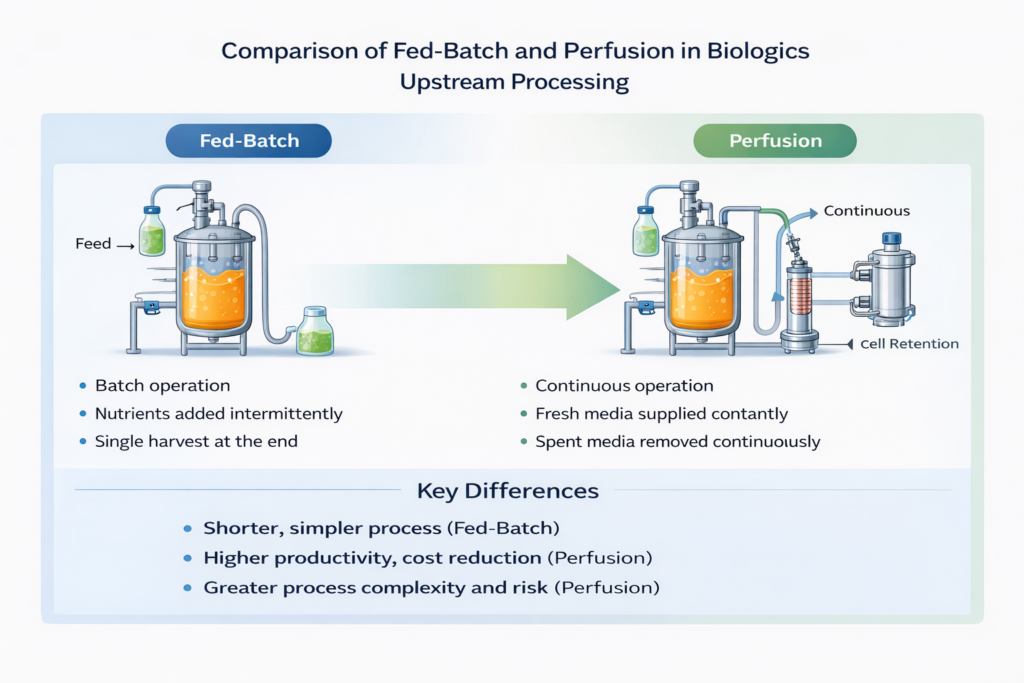
Fed batch is a semi-closed system in which nutrients are added during cultivation, and the product is harvested at the end of the culture. It is widely used due to its relative simplicity, scalability, and well-established platform knowledge.
Perfusion, in contrast, is a continuous or semi-continuous process in which fresh media is supplied while culture fluid is continuously removed, typically using a cell retention system such as alternating tangential flow (ATF) or tangential flow filtration (TFF). This enables much higher cell densities and volumetric productivity.
Previous studies have shown that perfusion can significantly increase productivity compared to fed batch, particularly for high-demand biologics (Clincke et al., Biotechnol Bioeng, 2013). However, this increase comes with additional process complexity and operational challenges.
Why Fed Batch Remains the Default
In most biologics development programs, fed batch is the starting point for both process development and manufacturing.
Key reasons include:
- Relatively simple process operation and control
- Shorter culture duration
- Lower risk of contamination
- Established scale-up strategies and platform processes
- Broad industry experience and regulatory familiarity
These factors make fed batch a robust and reliable baseline, particularly in early development stages.
Why Perfusion Is Introduced
Despite the advantages of fed batch, perfusion is introduced when higher productivity is required.
From a manufacturing perspective, perfusion offers:
- Significantly higher cell density
- Increased volumetric productivity
- Reduced facility footprint for the same output
- Lower cost per gram of product in high-demand scenarios
This is particularly relevant for products requiring large-scale supply, such as biosimilars or high-dose biologics, where production cost becomes a key competitive factor.
However, these advantages must be evaluated in the context of increased process complexity and operational risk.
Fed Batch vs Perfusion: Key Differences
From a practical standpoint, the main differences between Fed batch vs perfusion can be summarized as follows:
- Culture duration: shorter in fed batch, significantly longer in perfusion
- Cell density: moderate in fed batch, very high in perfusion
- Process operation: batch-oriented vs continuous or semi-continuous
- Media consumption: relatively low vs substantially higher
- Process complexity: lower vs significantly higher
These differences directly influence both process design and risk management.
Additional Considerations in Perfusion
Implementing perfusion requires careful consideration of factors that are not typically critical in fed batch processes.
Key considerations include:
- Cell retention systems (e.g., ATF, TFF) and their long-term stability
- Increased media consumption and associated logistics
- Process control complexity over extended culture duration
- Equipment reliability during continuous operation
- Monitoring and maintaining steady-state conditions
These factors introduce additional operational burden and require more advanced process understanding.
Risk Points in Perfusion Processes
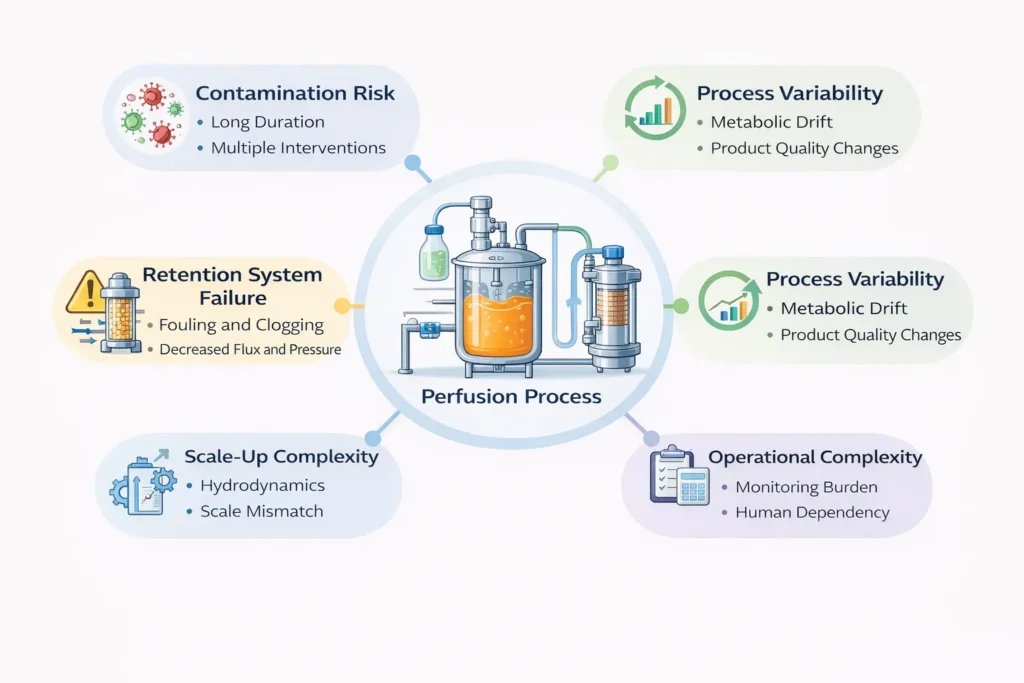
While perfusion offers clear productivity advantages, it also introduces several critical risk points that must be actively managed. These risks are not only described in literature but are often more pronounced in practical operation.
1. Contamination Risk Due to Extended Culture Duration
Perfusion processes typically operate over significantly longer durations compared to fed batch.
- Increased number of interventions (media exchange, sampling, adjustments)
- Prolonged exposure to the environment
- Greater dependency on aseptic operation
These factors collectively increase contamination risk, making robust process control and facility design essential.
2. Cell Retention System Stability
Cell retention systems (e.g., ATF, TFF, hollow fiber) are core components of perfusion processes.
From literature, membrane fouling and performance decline are well-recognized challenges due to:
- Cell debris accumulation
- Protein aggregation
- Increased culture viscosity
→ These factors can reduce filtration efficiency and impact process stability.
→ In practice (experience-based):
Hollow fiber or retention filters can progressively foul during long runs, leading to:
- Reduced flux and unstable perfusion rates
- Increased pressure and system stress
- Risk of unexpected process interruption
This is often one of the most critical operational risks in perfusion.
3. Process Variability During Long-Term Operation
Maintaining stable conditions over extended culture periods is inherently challenging.
- Drift in cell metabolism
- Accumulation of inhibitory byproducts
- Changes in product quality attributes over time
Even small deviations can accumulate and lead to significant variability in process performance.
4. Scale-Up and Scale-Down Complexity
Perfusion processes are known to present challenges in scale-up due to:
- Differences in hydrodynamics
- Shear stress variations
- Cell retention system behavior
→ These factors make direct scaling non-trivial.
→ In practice (experience-based): Developing a representative scale-down model is particularly difficult.
- Performance observed at GMP scale is not always reproducible at lab scale
- Simple parameter scaling (e.g., flow rate, volume) is often insufficient
- Equipment-specific factors (retention system dynamics, flow patterns) significantly affect outcomes
As a result, process understanding must go beyond theoretical scaling approaches.
5. Operational Complexity
Compared to fed batch, perfusion requires:
- Continuous monitoring and control
- More complex equipment operation
- Higher dependency on operator skill
This increases both operational burden and the potential for human error.
Key Takeaway
These risks are often the limiting factors in adopting perfusion, particularly in early-stage development or in facilities without prior experience. While literature describes many of these challenges conceptually, their actual impact is often more significant in real-world operation.
Why Perfusion Is Still Used
Despite these challenges, perfusion continues to be adopted in situations where its advantages outweigh the risks.
In particular, perfusion is justified when:
- High volumetric productivity is required
- Manufacturing capacity is limited
- Cost per gram must be reduced
- Market competition requires aggressive pricing strategies
In such cases, the additional complexity is managed through process optimization and operational control strategies.
Key Decision Considerations
From a CMC perspective, the choice between fed batch and perfusion is not based on theoretical advantages, but on overall process strategy.
Typical considerations include:
- Whether fed batch productivity is sufficient to meet demand
- Whether perfusion provides a meaningful cost advantage
- Whether the organization has the capability to manage increased complexity
- Whether process risks can be mitigated through development and control strategies
These factors determine whether perfusion is a justified strategic choice rather than a default option.
Conclusion
Fed batch vs perfusion are not simply alternative process modes, but represent different levels of process complexity and strategic intent.
Fed batch remains the standard approach due to its robustness and simplicity, while perfusion is selectively implemented to achieve higher productivity and improved cost efficiency.
Ultimately, perfusion is not inherently a better process, but a more demanding strategy that must be justified based on manufacturing needs, process capability, and economic considerations.
Related Links
- [Biologics Development Process: From Cell Line to Drug Product (Pillar Page)]
- [Cell Line Development in Biologics: CQA Definition and Clone Selection]
- Downstream Processing in Biologics: Purification Strategy and Process Design (TBD)