Introduction
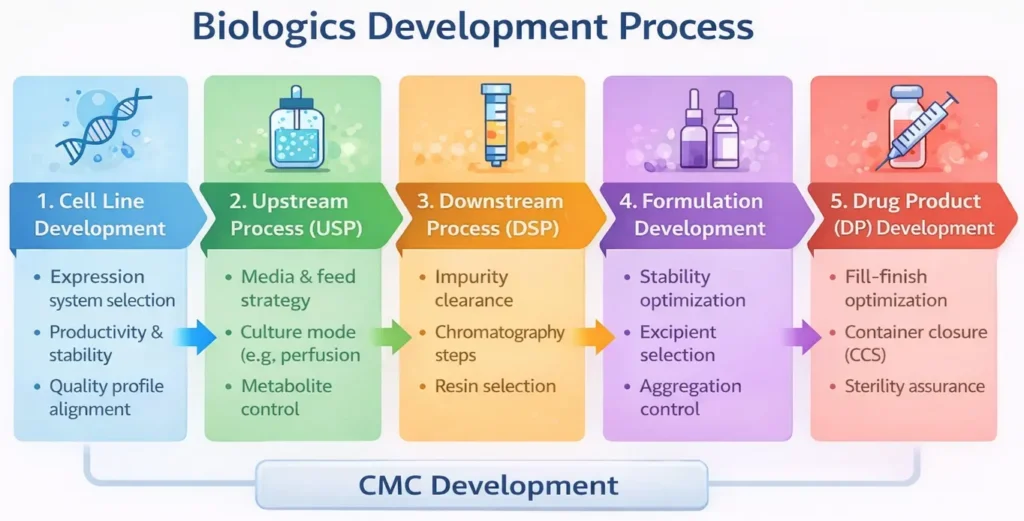
Biologics development follows a structured workflow from cell line development to final drug product manufacturing.
This process typically includes:
– Cell line development
– Upstream processing (USP)
– Downstream processing (DSP)
– Formulation development
– Drug product manufacturing
Each stage directly impacts product quality, stability, and manufacturability.
In practice, early development decisions often determine downstream success, especially at GMP scale.
This article provides a complete CMC-focused overview of the biologics development process, with practical insights from development to manufacturing.
* Biologics Development Process Flow
Cell Line → USP → DSP → Formulation → Drug Product
1. Cell Line Development
Cell line development defines the initial product quality profile and impacts all downstream processes.
Cell line development is the foundation of biologics production. It involves selecting and engineering host cells capable of producing the target protein with high productivity and stability.
Key considerations include:
– Expression system selection (e.g., CHO cells)
– Genetic stability
– Productivity and scalability
Beyond productivity, establishing an appropriate product quality profile at this stage is critical before progressing to downstream development.
Key attributes to evaluate include:
– Glycosylation profile (e.g., G0F, G1F, G2F distribution)
– Sialic acid content
– Charge variants (acidic/basic species)
– Aggregation propensity
– Post-translational modifications (e.g., oxidation, deamidation)
These attributes should be aligned with the target product profile, as they can significantly impact downstream process performance, formulation strategy, and ultimately clinical efficacy. Early alignment of critical quality attributes (CQAs) with the target product profile is essential to minimize rework during later development stages.
→ Read more:
– [What is Cell Line Development in Biologics? (Simple Explanation)]
– [Cell Line Development in Biologics: CQA Definition and Practical Considerations]
– [Critical Quality Attributes (CQAs) in Biologics Development] (TBD)
– [How Glycan Profiles Impact Biologics Function] (TBD)
2. Upstream Process (USP)
Upstream processing focuses on cell culture and expansion to produce the desired biologic molecule. From a development perspective, the goal is not only to maximize productivity but also to ensure consistent product quality and process robustness.
Key development considerations include:
– Media and feed strategy optimization
– Control of culture conditions (pH, temperature, dissolved oxygen)
– Metabolite control (e.g., lactate, ammonia)
– Process scalability and robustness
Different culture modes can be applied depending on the product and manufacturing strategy:
– Batch culture: Simple operation but limited productivity
– Fed-batch culture: Widely used approach with controlled nutrient feeding
– Perfusion culture: Continuous processing approach enabling high cell density and productivity
Perfusion systems, in particular, offer advantages such as improved productivity, stable culture environments, and potentially better control of product quality attributes. However, they also require more complex control strategies and process understanding. The choice of culture mode can significantly impact both upstream performance and downstream processing efficiency, as well as overall manufacturing strategy.
→ Read more:
– [Upstream Processing in Biologics] (TBD)
– [Fed Batch vs Perfusion : Key Differences, Risks and Process Strategy]
– [Media Optimization Strategies in Cell Culture] (TBD)
– [Metabolite Control in Bioreactors] (TBD)
– [Scaling Up Biologics Upstream Processes] (TBD)
3. Downstream Process (DSP)
Downstream processing focuses on the purification of the biologic product from cell culture components. From a development perspective, the primary objective is to achieve consistent product quality by effectively removing process- and product-related impurities.
Key development considerations include:
– Impurity clearance strategy (HCP, DNA, aggregates)
– Chromatography step selection and sequencing
– Resin selection and lifetime considerations
– Process robustness and scalability
A typical downstream process for monoclonal antibodies includes:
– Capture step: Protein A chromatography for initial product isolation
– Intermediate purification: Removal of host cell proteins and DNA
– Polishing steps: Removal of aggregates, charge variants, and residual impurities
Rather than applying a fixed platform process, downstream development requires a tailored strategy based on the specific product profile and impurity characteristics.
For example:
– Aggregate-prone molecules may require enhanced polishing strategies
– Charge variant distribution may influence ion exchange conditions
– High HCP levels may require additional purification steps
Process design decisions at this stage can significantly impact yield, product quality, and overall manufacturability. Early definition of impurity control strategy is critical to ensure consistency during process validation and regulatory submission.
→ Read more:
– [Downstream Processing in Biologics: Process Flow and Development Strategy]
– [Why UF/DF Buffer Exchange Is Critical in Biologics (Stability & Formulation Impact)]
– [UF/DF Troubleshooting Biologics: Common Issues and Hidden Risks]
– [Polishing Strategies for Monoclonal Antibodies] (TBD)
– [HCP and DNA Removal in Biologics] (TBD)
4. Formulation Development
Formulation development plays a critical role in ensuring the stability, efficacy, and manufacturability of biologic products. From a development perspective, the goal is to design a formulation that maintains product quality throughout storage, handling, and administration.
Key development considerations include:
– Stability optimization under various stress conditions
– Buffer selection and pH optimization
– Excipient screening (e.g., sugars, surfactants, amino acids)
– Control of aggregation and particle formation
– Compatibility with manufacturing processes and container systems
A major focus in formulation development is understanding and mitigating degradation pathways, such as:
– Aggregation
– Oxidation
– Deamidation
– Fragmentation
Formulation strategies should be designed to address these risks through a combination of buffer systems, stabilizers, and process conditions.
Additionally, formulation development must consider downstream implications, including:
– Freeze-thaw stability
– Compatibility with filtration and filling processes
– Impact on drug product manufacturing (e.g., viscosity, concentration limits)
Early formulation decisions can significantly influence drug product design, stability profiles, and overall development timelines. A risk-based formulation approach is often required to balance stability, manufacturability, and delivery requirements.
→ Read more:
– [Biologics Formulation Strategy: Beyond Stability and Towards Development Design]
– [Why SC Conversion Has Become So Important in Biologics]
– [Excipient Selection in Biologics Formulation] (TBD)
– [pH and Buffer Optimization for Protein Stability] (TBD)
– [Freeze-Thaw Stability in Biologics] (TBD)
5. Drug Product (DP) Development
Drug product development focuses on ensuring that the formulated biologic can be consistently manufactured, stored, and delivered without compromising product quality. From a CMC perspective, this stage integrates formulation design, manufacturing processes, and container system considerations.
1) Product Design Considerations
Key aspects of product design include:
– Lyophilization cycle development (if applicable)
– Viscosity control for high-concentration formulations
– Container closure system (CCS) selection and compatibility
– Extractables & leachables (E&L) risk assessment
Lyophilization requires optimization of freezing, primary drying, and secondary drying conditions to ensure product stability and cake quality. For liquid formulations, viscosity is a critical parameter, particularly for prefilled syringe (PFS) systems, as it impacts both manufacturability and injectability.
2) Process Considerations
DP development must also consider how manufacturing processes affect product quality:
– Sterile filtration performance
– Adsorption or loss during filtration and filling
– Compatibility with filling systems
– Impact of processing conditions on stability
3) Manufacturing Risk Control
A critical aspect of DP development is managing risks during manufacturing:
– Hold time stability across stages (e.g., bulk, formulated solution, pre-/post-filtration)
– Sterile filtration integrity
– Pre-use post-sterilization integrity testing (PUPSIT)
– Aseptic processing robustness
Hold time studies define acceptable processing windows and ensure product stability throughout manufacturing. PUPSIT is an essential control to ensure filter integrity and sterility assurance, and is increasingly emphasized in regulatory expectations. Overall, drug product development requires a holistic approach to balance stability, manufacturability, and patient usability.
→ Read more:
– [Drug Product Development in Biologics: From Formulation to Final Product]
– [Why Companies Still Choose Lyophilized Biologics]
– [Viscosity Challenges in High-Concentration Biologics] (TBD)
– [Container Closure Systems (CCS) in Biologics] (TBD)
– [Extractables and Leachables (E&L) in Biologics] (TBD)
– [Hold Time Studies in Biologics Manufacturing] (TBD)
– [PUPSIT in Sterile Filtration: Regulatory and Practical Considerations] (TBD)
Conclusion
Understanding the biologics development process is not just about individual steps, but about how early decisions shape the entire product lifecycle.
From a CMC perspective, alignment between development stages is essential to ensure product quality, manufacturability, and regulatory success.
In practice, failures often originate from early-stage decisions that were not aligned with downstream requirements.